
CSTR: Continuous flow Stirred Tank Reactor
Continuous-flow technology for heterogeneous biomass.
What a stirred-tank reactor is and what it is used for
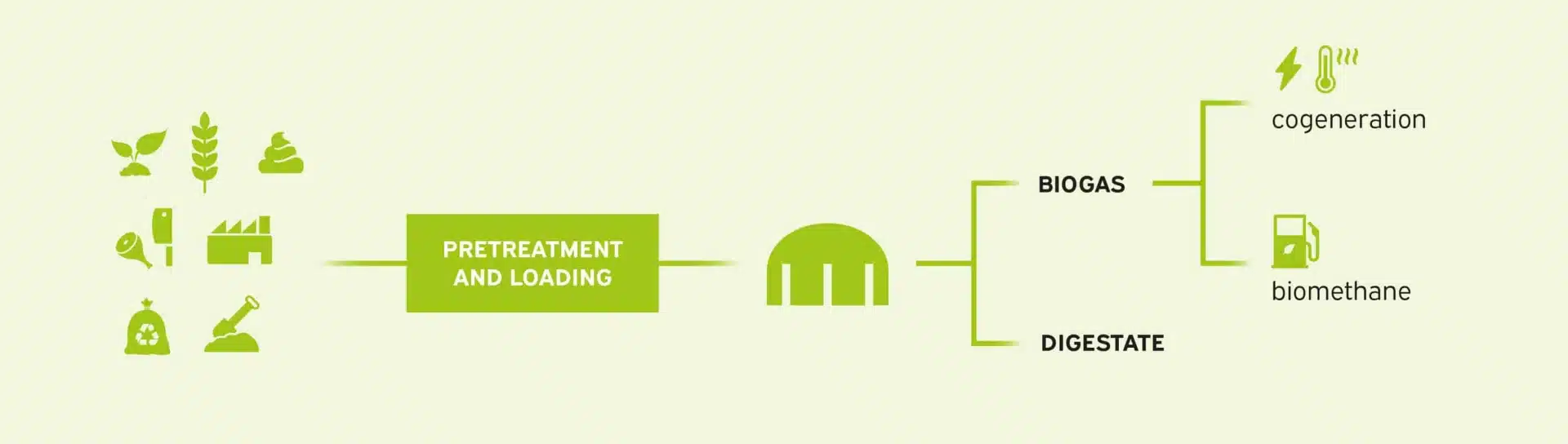
These reactors are used for the production of energy from biogas or biomethane and are suitable for the anaerobic digestion of heterogeneous biomass, from livestock effluents and agricultural by-products to agro-industrial waste or OFMSW.
Do you want to turn your idea into a solid, feasible project?
How the CSTR works
Advantages of the reactor
- Flexible technology capable of effectively managing different types of biomass
- Simple and optimized maintenance, minimizing plant downtime and maximizing energy production
- High buffering capacity against pH variations: it maintains optimal reaction conditions and ensures process stability
- Reduced self-consumption thanks to the optimization of plant operating times by the control system
The CSTR reactor is therefore suitable for the anaerobic digestion of heterogeneous and complex biomass from the agricultural and industrial sectors.
Livestock effluents
Agricultural by-products
Industrial by-products
OFMSW
Structure and use of CSTR
- One or more digesters, circular tanks made of concrete or steel
- A mixing system composed of slow and fast mixers, vertical or inclined, depending on the type and quantity of biomass in the digesters
- An internal or external heating system
- One or more gasholder covers on the digesters
In this type of reactor, anaerobic digestion takes place at controlled temperatures and with a dry matter content of between 5% and 10%.
The digestion process can operate under mesophilic conditions, around 40 °C, or thermophilic conditions, around 55 °C, with hydraulic retention times ranging from 20 to 60 days, depending on the types of biomass used to feed the plant.
CSTR are a mature and well-established technology that enables the construction of high-performing agricultural, industrial, or OFMSW biogas plants.


DRY SUBSTANCE

THERMAL REGIME

HYDRAULIC RETENTION TIME

MIXING SYSTEM
Hydraulic retention time in CSTR
The hydraulic retention time is variable and depends on the types of biomass used to feed the plant. It can range from 20 to 60 days, depending on the type and quantity of biomass present in the digester.
Choosing the correct residence time is crucial for reactor performance, as it affects the conversion of the organic fraction into biogas.
Difference between batch and continuous stirred-tank reactors (CSTR)
In batch reactors, the process takes place in separate batches: the reaction begins with the introduction of all reactants into the reactor, followed by a reaction period and, finally, the removal of the products.
This approach may be suitable for processes requiring more flexible management of production phases, but it can involve downtime between each batch.
On the other hand, Continuous Stirred-Tank Reactors (CSTR) operate with a continuous flow: fresh biomass is continuously fed and constantly mixed at a controlled temperature to ensure perfect homogenization.
This process therefore enables constant biogas production and better management of process variables.
What is the difference between CSTR and plug-flow reactors (PFR)?
The main difference between CSTR and PFR lies in the feeding system and the dry substance content of the feedstocks treated.
CSTR are particularly suitable for treating biomass with a dry substance content generally between 5% and 10%.
By contrast, plug-flow reactors are suitable for denser and more fibrous biomass, with a higher dry substance content ranging between 15% and 35%.
FAQ – Frequently asked questions about CSTR technology
Which biomass feedstocks can be used in a CSTR reactor?
- Animal manure (cattle, pigs, poultry, etc.)
- Agricultural residues (crop residues, straw, silage, etc.)
- Agro-industrial by-products (fruit and vegetable waste, processing residues)
- Organic municipal waste
- Slaughterhouse waste and food industry waste
How many types of biomass can be used in the plant’s feed mixture?
Which mixing system is used in the digester?
Get More Information
Submit your request and we will get back to you by email or phone as soon as possible.
* All fields are required.